DHUnplugged is now streaming live - with listener chat. Click on link on the right sidebar.
Love the Show? Then how about a Donation?
Follow John C. Dvorak on Twitter
Follow Andrew Horowitz on Twitter
Warm-Up
- 250 Years!
- We have the scorecard
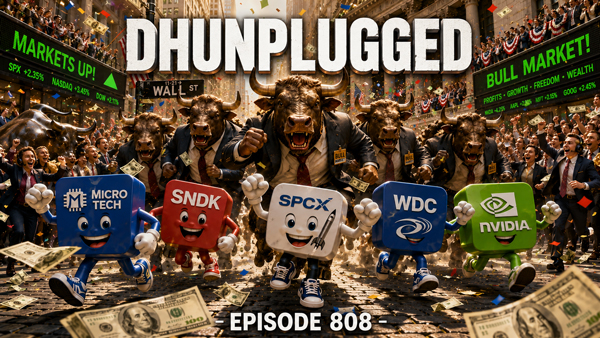
- Bulls are on the loose!
- Kevin Hassett - what a putz
- RAM JOB!
Markets
- Google's first day in the DJIA - a good one
- SpaceX bonds already losing
-Yen slips to 1986 levels - Yentervention?
WHAT A PUTZ!
- Trump Accounts launch July 4, with the NYSE and Nasdaq set to ring the opening bell from the Oval Office.
- Program gives a $1,000 Treasury-funded investment account to U.S. children born from January 1, 2025 through December 31, 2028.
- Kids under 18 can have accounts, but only newborns in that four-year window get the federal seed money.
- Parents, family, employers, nonprofits, and governments can add money, with a general $5,000 annual contribution cap.
- Money is invested in index funds and generally locked up until the child reaches adulthood.
- Kevin Hassett pitched it as a way to teach kids about markets, ownership, saving, and compounding. His argument is that the more young people get exposed to investing early, and market ownership becomes less of an upper-income club.
- However - > the government is handing out taxpayer-funded brokerage seed money while selling it as capitalism.
- Also odd: the benefit may skew toward families who already know how to file forms, open accounts, and add more money.
- So basically it is a forced financial-literacy experiment wrapped in a political brand name, with a socialist starter check to teach capitalism.
First-Half Winners and Losers
- S&P 500 finished the first half up roughly 7% to 8%, with the rally led by AI hardware, chips, memory, and data-center infrastructure.
- Biggest winners were the shovel sellers: Sandisk up about 780%, Micron up about 296%, Western Digital up about 240%, Seagate up about 226%.
- Overseas AI hardware ripped too: South Korea's Kospi up 123%, helped by Samsung up 169% and SK Hynix up 303%.
- Semiconductor ETFs had a monster Q2: iShares Semiconductor ETF up 86.8%, VanEck Semiconductor ETF up 64.8%.
- Japan's Nikkei rose about 38%; FTSE 100 gained about 5.8%.
- Losers were the software/platform names that could not prove immediate AI payoff.
- Microsoft was down about 24% despite being one of the biggest AI spenders.
- Momentum stocks had one of their worst stretches in two decades as the Magnificent Seven slipped on capex worries.
- Crypto and gold also lagged the AI-infrastructure trade.
- Equity BULLS are running like it was San Fermin, Spain...
MORE....
- Gold biggest quarterly loss since 2013
- Japan best quarter ever
- Oil starts and ends
- Kospi best quarter in 30 years
- Stoxx 600 best Q in 5 years
Something is going to break!
- When Micro announced earnings, and we see that companies are panicking (News about existential threat to smaller tech players).. We said something is going to break
- MU shares lifted to ATH on the news - big big beat - Micron’s latest quarter showed a dramatic acceleration from the year-ago period, with revenue rising from $9,301 to $41,460 and EPS increasing from $1.91 to $25.11.
- HUGE uptick in guidance
- Apple increased pricing, Dell is increasing prices next week (17%), Microsoft raised price on XBox, HP across the board increase, Lenovo/Xiaomi increases,
- NOW: Apple is lobbying the Trump administration for clearance to buy memory chips from China's ChangXin Memory Technologies
Korea Goes All-In On AI Memory
- Samsung and SK Hynix are backing a huge South Korea chip buildout tied to AI memory, HBM, advanced DRAM, packaging and data centers.
- Samsung’s plan includes hundreds of trillions of won for new fabs, including HBM facilities in Cheonan and Onyang.
- SK Hynix is expanding Yongin and planning a major new chip base as it rides demand from Nvidia-linked HBM supply.
- Government angle: Seoul wants domestic chip capacity treated like national infrastructure, not just corporate capex.
- The state is trying to lock in supply-chain control before China, Taiwan, Japan and the U.S. pull more production into their own subsidy zones.
- Market wrinkle: AI memory is hot now, but memory companies have a long history of overbuilding into strong pricing cycles.
- Governments are no longer just subsidizing chips — they are helping plan semiconductor cities.
RAM Job?
- Samsung, SK hynix, and Micron were hit with a U.S. antitrust class-action lawsuit over alleged DRAM price fixing.
- Allegation: the big three coordinated supply cuts while shifting capacity away from regular DDR3/DDR4 memory and into high-bandwidth memory for AI servers.
- Plaintiffs say the three companies control roughly 90% of the DRAM market.
- Conventional DRAM prices allegedly jumped about 700% over four years.
- Complaint argues that in a normal commodity market, at least one supplier would usually increase production when prices spike.
- Instead, the lawsuit says all three moved in the same direction at the same time.
DRAM: We Have Seen This Movie Before
- Yes, there was a similar DRAM price-fixing scandal in the 2000s.
- DOJ investigation covered alleged DRAM price fixing from roughly 1998 through 2002.
- Hynix pleaded guilty in 2005 and agreed to pay a $185 million criminal fine.
- Samsung pleaded guilty in 2005 and agreed to pay a $300 million criminal fine.
- Infineon pleaded guilty earlier, in 2004, and agreed to pay a $160 million fine.
- Micron was involved in the investigation but received amnesty/cooperation treatment rather than the same criminal fine path.
- Several executives were also charged or pleaded guilty.
- State AGs and private plaintiffs later pursued civil cases tied to overpayment claims.
- Difference now: the new case is not yet proven and appears focused on alleged coordinated supply restriction during the AI/HBM boom.
Chevron and Microsoft
- Chevron Corp signed 20-year deal with Microsoft for data center power.
- Agreement supplies natural-gas fired generation for massive West Texas facility.
- Project Kilby expected online 2028, ramping to 2.67 gigawatts.
- Full output enough to power more than 530,000 Texas homes.
- Chevron partnering Engine No. 1, final investment decision planned later.
- Deal follows prior reports of exclusive long-term power negotiations.
More Oil News - Drill baby Drill
- Interior Department cutting federal drilling bonds by 95% to spur exploration.
- Required bond drops from $500,000 to $25,000 for leases.
- Bonds ensure cleanup costs don’t fall on taxpayers if wells abandoned.
- Policy change aims to encourage more oil and gas development.
- Proposal subject to 60-day public comment after Federal Register publication.
Dow 52,000 and the Tech Bounce
- Dow closed above 52,000 for the first time Monday, finishing at 52,182.74.
- S&P 500 gained 1.18%; Nasdaq jumped 2.07%.
- S&P and Nasdaq snapped five-session losing streaks.
- Alphabet rose 4.8% on its first day as a Dow component.
- Tesla gained 8.5%; SpaceX rose more than 7%.
- The bounce came after last week's tech selloff, with investors rotating back into mega-cap and AI names.
Comcast Breaks Itself Up
- Comcast plans to split media and connectivity into two separate companies.
- NBCUniversal and Sky would be spun off in a tax-free deal; Comcast keeps broadband, wireless, and cable.
- Completion expected within a year.
- Shareholders would own both Comcast and the new NBCUniversal.
- Comcast shares rose on the news; Charter also jumped as investors speculated Comcast could eventually pursue a broadband-scale deal.
AI Trade Gets a Warning Label
- Bank for International Settlements flagged the AI boom as a financial-stability risk.
- The main concerns: elevated valuations, investor complacency, complex funding structures, and debt financing across the AI supply chain.
- BIS also warned that record public debt and leveraged hedge-fund activity in sovereign bonds could amplify shocks.
- Quote from BIS General Manager Pablo Hernandez de Cos: "Policy actions must reinforce each other."
- The interesting part: central bankers are not saying AI is fake; they are saying the financing stack may be fragile.
Inflation Back Above 4%
- BEA's PCE price index rose 4.1% year over year in May.
- April was 3.8%; March was 3.5%; February was 2.9%.
- This keeps pressure on the Fed because PCE is the Fed's preferred inflation gauge.
- Core PCE may later be revised lower because of BEA methodology changes.
- Goldman estimated May core PCE could be trimmed to 3.2% from 3.4%; JPMorgan expected 3.3%.
- Funny-but-real detail: part of the potential revision comes from how BEA prices portfolio management, legal services, and computer software.
Jobs Report Becomes Bad-News-Is-Bad-News
- June payrolls are due Thursday because markets are closed Friday for Independence Day.
- The setup is awkward: strong jobs could mean stronger economy, but also higher odds of Fed hikes.
- Looking back - May payrolls were hot at 172,000 versus an 85,000 forecast, with unemployment steady at 4.3%.
- Remember - after the June Fed meeting, policymakers were clearly focused on inflation, not rescue cuts.
Oil, Iran, and the Market's New Weird Routine
- Oil stayed volatile around renewed U.S.-Iran tensions and peace-talk headlines.
- Brent rose 1.6% Monday to $73.15; WTI rose 2.2% to $70.75.
- Markets rallied anyway, helped by signs talks would resume and shipping routes were stabilizing.
- The odd market behavior: geopolitical escalation keeps getting followed by de-escalation headlines and risk-on rallies.
- This is now part of the trading pattern: weekend war scare, Monday relief rally, repeat.
--- New attacks by USA on Iran happened at approx 4:30PM on Friday (markets closed) and then a halt to the fighting on Sunday - before the futures opened.
Odd : Wendy's Becomes a Meme Stock
- Wendy's became the latest retail-trader short-squeeze target.
- Stock surged 25% last Wednesday, then gained another 9% Thursday.
- Barron's said the move followed a CFO shakeup and WallStreetBets attention.
- New CFO Steve Cirulis came from Potbelly and is also taking the Chief Strategy Officer title.
- Wendy's had fallen 47% over the past year before the rally.
- Short interest was nearly 30% of the public float, making the stock easier to squeeze.
- Trian, Nelson Peltz's firm, owned nearly 15 million shares valued around $93 million.
SpaceX Bonds Slip After Big Debut
- SpaceX sold $25 billion of investment-grade bonds, its first major public debt deal.
- Demand was huge, with roughly $85 billion to $98 billion of orders.
- The 10-year tranche priced about 1.4 percentage points over Treasurys.
- Bonds weakened quickly after pricing.
- The 10-year yield rose near 6%, with the spread moving above 1.6 percentage points.
- Longer-dated 2046 and 2056 bonds took the most pressure.
- The pushback: bond buyers want more yield for a company still funding rockets, Starlink, AI/data-center spending, and Mars ambitions.
- Clean read: equity investors bought the story; bond investors immediately marked it down.
Yentervention
- Yen weakened again, pushing toward the 162-per-dollar zone and near its weakest level in about 40 years.
- Japan keeps warning it is ready for "decisive action" or to respond "at any time."
- Market does not seem scared for long.
- Japan already spent heavily defending the yen, including a roughly $73 billion yen-buying operation after the currency broke past 160.
- U.S. rates are still high, the Fed is not rushing to cut, and the Bank of Japan is still moving slowly.
- That keeps the carry trade alive: borrow cheap yen, buy higher-yielding dollars.
- Japan's foreign reserves fell 5.6% in May after intervention, showing the defense is expensive.
Love the Show? Then how about a Donation?

THE CLOSEST TO THE PIN
for SpaceX (SPCX)
Winners will be getting great stuff like the new "OFFICIAL" DHUnplugged Shirt!
FED AND CRYPTO LIMERICKS